


Hi Gang…
Did you know that the first two fiberglass sports cars produced by Glasspar were based on a Willys chassis and engine? That’s significant and I wanted to learn more – but what I found out was far more interesting that I could have imagined.
The prewar Willys cars have a wonderful history, but the information is not readily available. In fact, no one has written a book that talks about Willys as a manufacturer, and what a great book this would be about a company with a strong manufacturing and design background. Sign me up to buy the first copy, gang!
So, in researching this article I turned to good friend and automotive historian Alden Jewell who has one of the most extensive automotive literature collections I’m aware of – and very detailed knowledge of Willys history. Like us, Alden favors the independent and orphan car makes, and both Willys and Kaiser are two of his favorite.
So, last night we concluded our coast to coast research (Alden is in California and I’m in Florida) about 3am my time and today is the result of our collaboration. Thanks Alden!
Let’s begin.
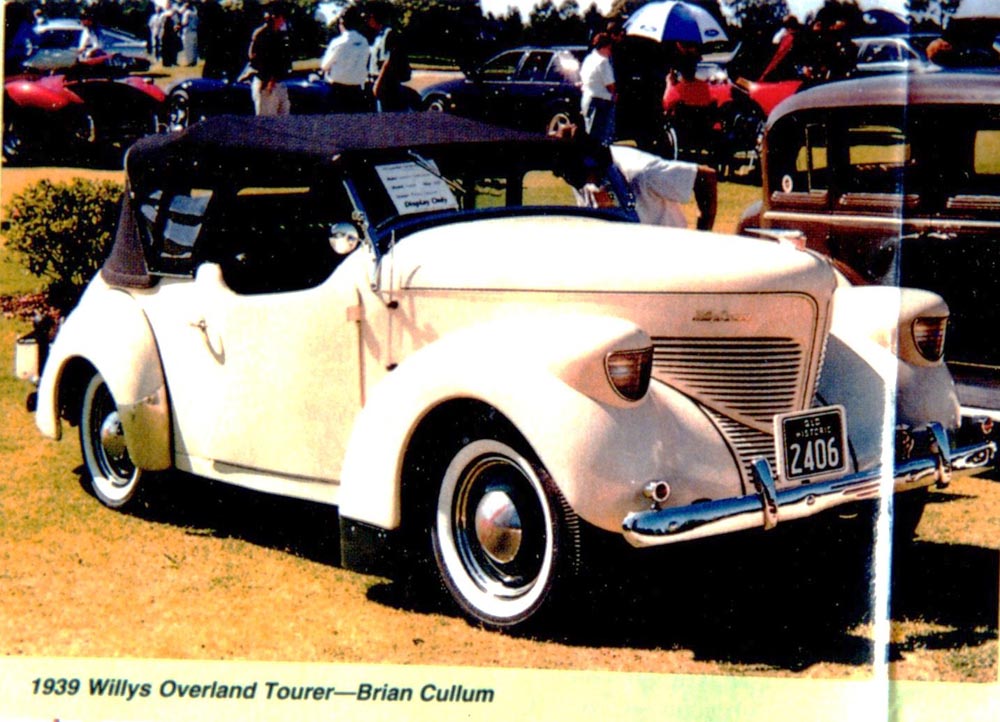
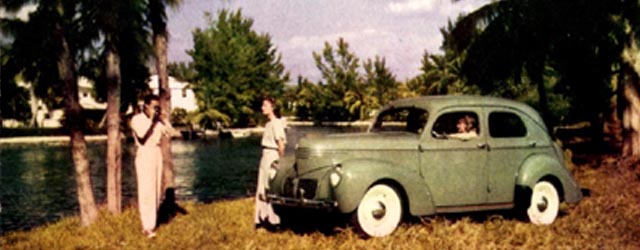
Here’s a Hand-Crafted 1939 “Sharknose” Willys Sport Custom. This Was Not Offered By The Factory – But Is A Favorite Of Both Alden’s And Mine.
Why Study Willys?
Great question and the answer is two-fold – with bonus points (remember gang….I’m a school teacher so bonus points count) 😉
- Because of the short approximately 100” wheelbase, Willys cars formed the basis of many custom, sport custom, and fiberglass sports cars in the postwar era. True, there were far more of these cars based on a modified Ford chassis, but imagine if you found a prewar Willys with approximately 100” wheelbase. Think of the time you would have saved building your car. If you found a Willys frame, you immediately moved onto the next step about engine placement and body purchase / design.
- Not only was a Willys frame and engine used in the first two cars built by Bill Tritt of Glasspar (the Brooks Boxer and Alembic I – called “Factory Cars” gang), Willys returned to our “area of interest” in the Fall of ’52 when “Woody” Woodill contacted Bill Tritt and Shorty Post to build the first prototype Woodill Wildfire Sports Cars – built utilizing Willys components. Then, Woodill moved aggressively forward trying to create a Willys Sportscar with the folks at Willys in Toledo, Ohio
- Bonus Points: After Willys Motors was purchased by Kaiser in the Spring/Summer of ’53, the fiberglass sports cars known as Kaiser Darrins were built at the Willys plant in Jackson, Michigan.
Lots of Willys history related to fiberglass cars, and this is every reason why the history of Willys Motors deserves our recognition and respect here at Forgotten Fiberglass.
So let’s have at it and take a look at the history of Willys Motors. We’ll focus on the immediate prewar era from ’37 to ’42. And off we go 🙂
And remember….use your mouse to click on any image here at Forgotten Fiberglass to make the image appear larger on your screen.
1934 Willys (pictures below):
Models:
- Factory/Dealer Model 38
- Series / Trim Levels: “Standard,” “Deluxe,” and “Custom”
- Information Taken From Motor Annual Show Number
- Note: Alden and I continue to find reference to “model 48” – most recently in brochures showing 3 1938 half-tonner truck Models. There is not a consistent pattern to this yet – as found in vintage material – not recent contemporary explanations. Research continues.
Special Model: Clipper (and Clipper Deluxe)
- Research so far shows the Clipper model was available only in ‘38
- The Clipper was a two door sedan – economy model
Specifications:
- Wheelbase: 100”
- Engine: 4 cylinder (used from ’33-’40)
- Horsepower: 48
- Transmission: 3 speed manual floor mounted shifter – no overdrive option was available
- Brakes: mechanical
- Production: 16,173
Highlights:
- ’37-’38 Willys virtually same car
- Last year for mechanical brakes
INSERT PICTURES HERE
1935 Willys (pictures below):
Models:
- Factory/Dealer Model 38
- Series / Trim Levels: “Standard,” “Deluxe,” and “Custom”
- Information Taken From Motor Annual Show Number
- Note: Alden and I continue to find reference to “model 48” – most recently in brochures showing 3 1938 half-tonner truck Models. There is not a consistent pattern to this yet – as found in vintage material – not recent contemporary explanations. Research continues.
Special Model: Clipper (and Clipper Deluxe)
- Research so far shows the Clipper model was available only in ‘38
- The Clipper was a two door sedan – economy model
Specifications:
- Wheelbase: 100”
- Engine: 4 cylinder (used from ’33-’40)
- Horsepower: 48
- Transmission: 3 speed manual floor mounted shifter – no overdrive option was available
- Brakes: mechanical
- Production: 16,173
Highlights:
- ’37-’38 Willys virtually same car
- Last year for mechanical brakes
INSERT PICTURES HERE
1936 Willys (pictures below):
Models:
- Factory/Dealer Model 38
- Series / Trim Levels: “Standard,” “Deluxe,” and “Custom”
- Information Taken From Motor Annual Show Number
- Note: Alden and I continue to find reference to “model 48” – most recently in brochures showing 3 1938 half-tonner truck Models. There is not a consistent pattern to this yet – as found in vintage material – not recent contemporary explanations. Research continues.
Special Model: Clipper (and Clipper Deluxe)
- Research so far shows the Clipper model was available only in ‘38
- The Clipper was a two door sedan – economy model
Specifications:
- Wheelbase: 100”
- Engine: 4 cylinder (used from ’33-’40)
- Horsepower: 48
- Transmission: 3 speed manual floor mounted shifter – no overdrive option was available
- Brakes: mechanical
- Production: 16,173
Highlights:
- ’37-’38 Willys virtually same car
- Last year for mechanical brakes
INSERT PICTURES HERE
1937 Willys (pictures below):
Models:
- Factory/Dealer Model 37
- Series / Trim Levels: “Standard” and “Deluxe”
- Information Taken From Motor Annual Show Number
Specifications:
- Wheelbase: 100”
- Engine: 4 cylinder (used from ’33-’40)
- Horsepower: 48
- Transmission: 3 speed manual floor mounted shifter – no overdrive option was available
- Brakes: mechanical
- Production: 76,803
Highlights:
- ’37-’38 Willys virtually same car
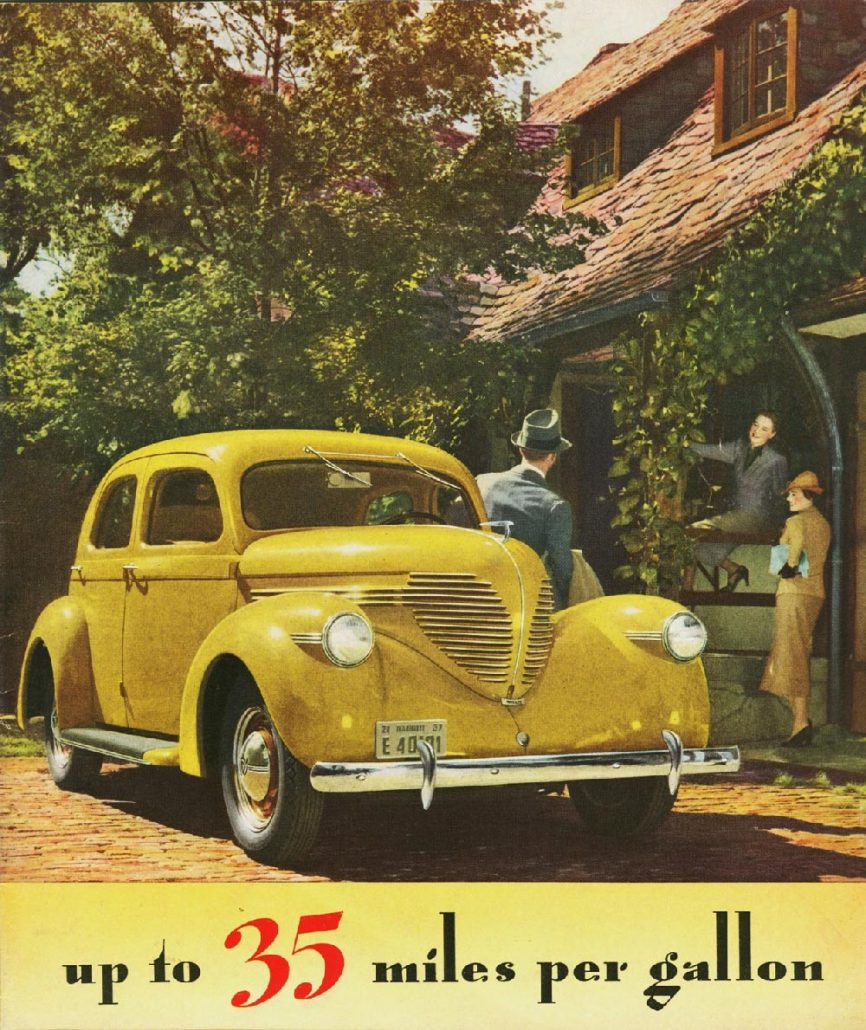
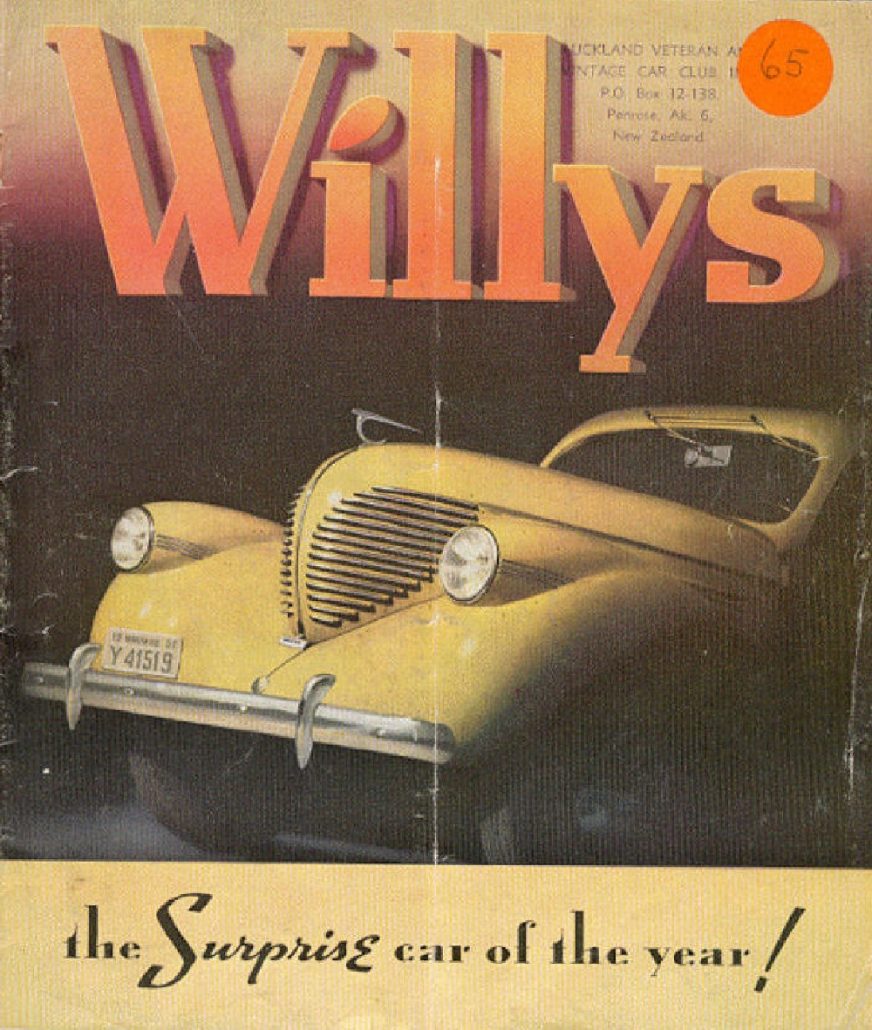
- ’37 was the first year for new body style shown below
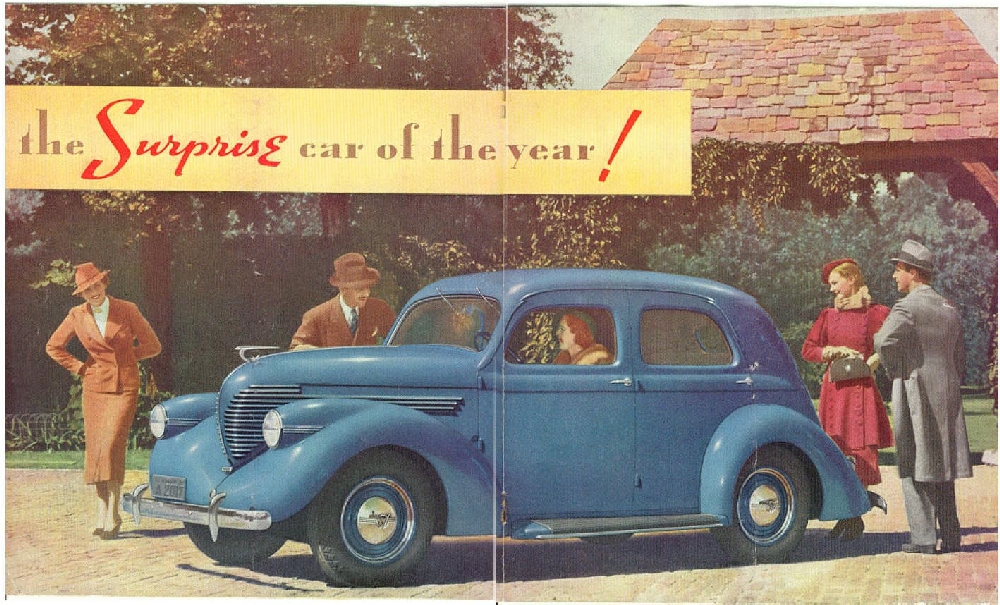
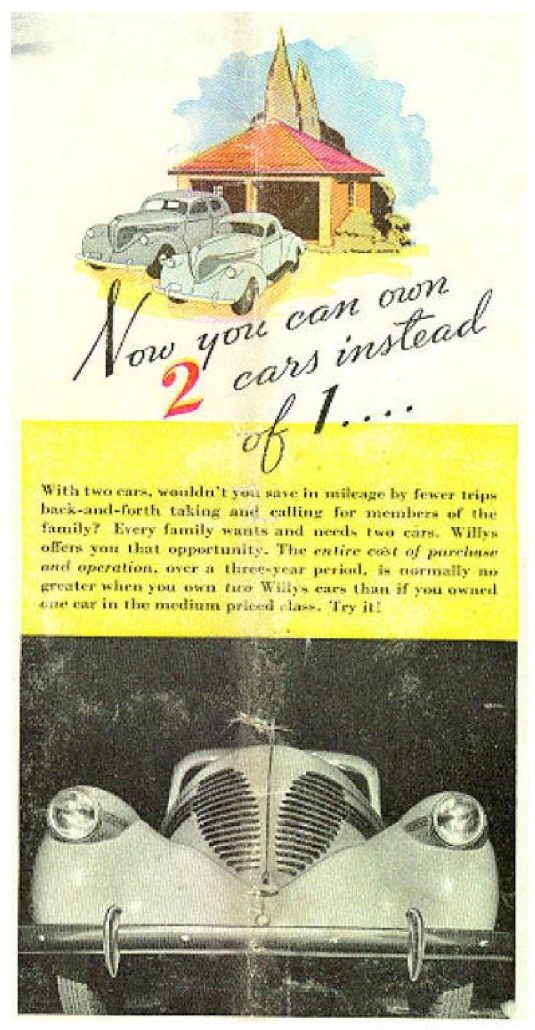
1938 Willys (pictures below):
Models:
- Factory/Dealer Model 38
- Series / Trim Levels: “Standard,” “Deluxe,” and “Custom”
- Information Taken From Motor Annual Show Number
- Note: Alden and I continue to find reference to “model 48” – most recently in brochures showing 3 1938 half-tonner truck Models. There is not a consistent pattern to this yet – as found in vintage material – not recent contemporary explanations. Research continues.
Special Model: Clipper (and Clipper Deluxe)
- Research so far shows the Clipper model was available only in ‘38
- The Clipper was a two door sedan – economy model
Specifications:
- Wheelbase: 100”
- Engine: 4 cylinder (used from ’33-’40)
- Horsepower: 48
- Transmission: 3 speed manual floor mounted shifter – no overdrive option was available
- Brakes: mechanical
- Production: 16,173
Highlights:
- ’37-’38 Willys virtually same car
- Last year for mechanical brakes
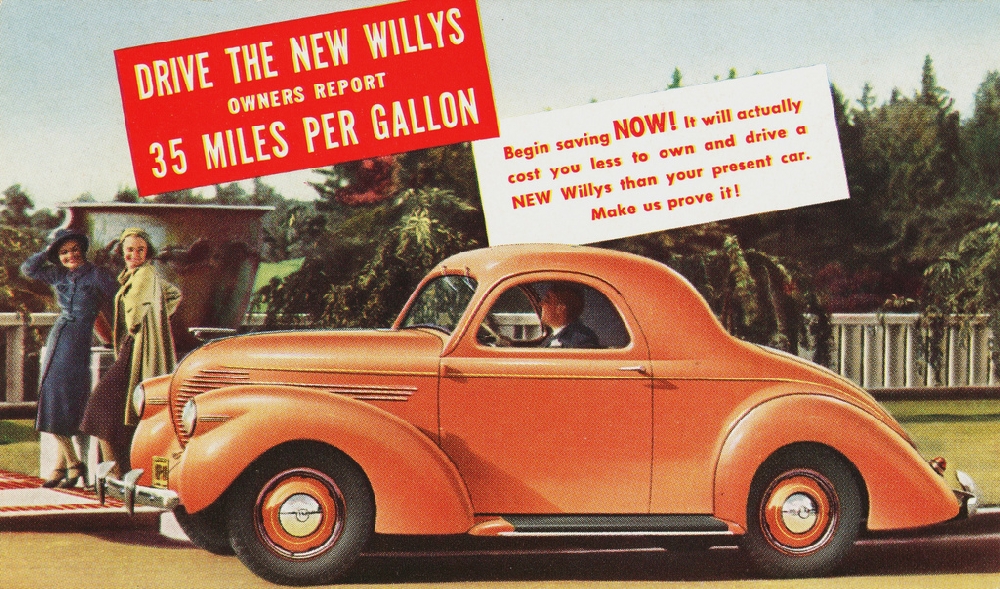
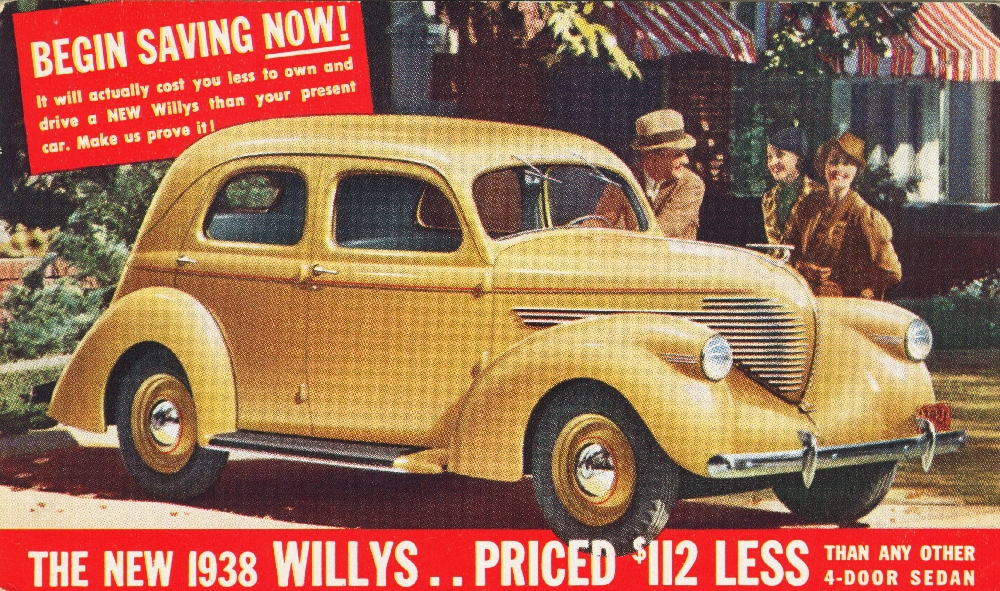
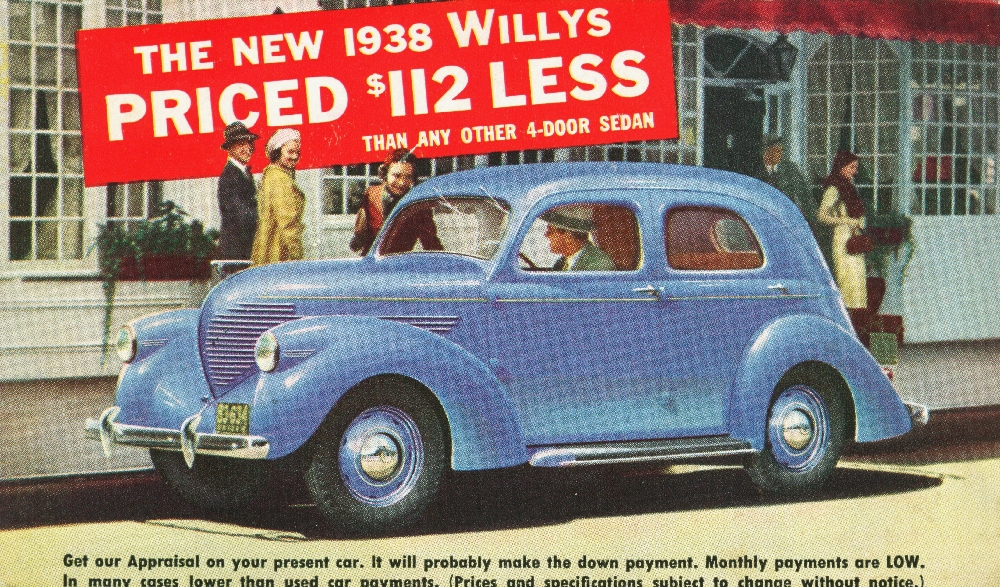
1939 Willys (pictures below):
Models:
- Factory/Dealer Model 39
- Series / Trim Levels: “Speedway,” “Special Speedway,” and “Deluxe”
- Information Taken From Motor Annual Show Number
Special Model: Californian
- Research so far shows that it was produced in the California Willys plant in the Los Angeles area.
- Probably sold on West Coast of USA only.
- Research so far shows this model featured unique interior and exterior trim
- Offered in ’39 and ’40
Specifications:
- Wheelbase: 100”
- Engine: 4 cylinder (used from ’33-’40) – called the “Super Thrift” engine
- Horsepower: 61
- Transmission: 3 speed manual floor mounted shifter – no overdrive option was available
- Brakes: hydraulic
- Production: 25,383
Engine Specifications From Brochure:
- Standard Compression ratio: 6.35 to 1
- High altitude head: 6.81 to 1
- Aluminum hi-compression head: (Not listed as available in brochures. However, the September 1939 issue of Motor Magazine states the following: “A special coupe model in the de luxe line is equipped with a 7 to 1 aluminum head which gives it a maximum speed of 80 mph, it is stated.”)
Highlights:
- First year for larger engine at 61 horsepower
- Horsepower increased 27% from 48 to 61 horsepower
- First year for hydraulic brakes
- Initially in ’39, the Willys car was simply called the “Overland.” Later it was called the “Willy Overland” or just “Willys.
- The new model sported an updated front end which resembled the Graham Sharknose in design. This style was used for one year only.
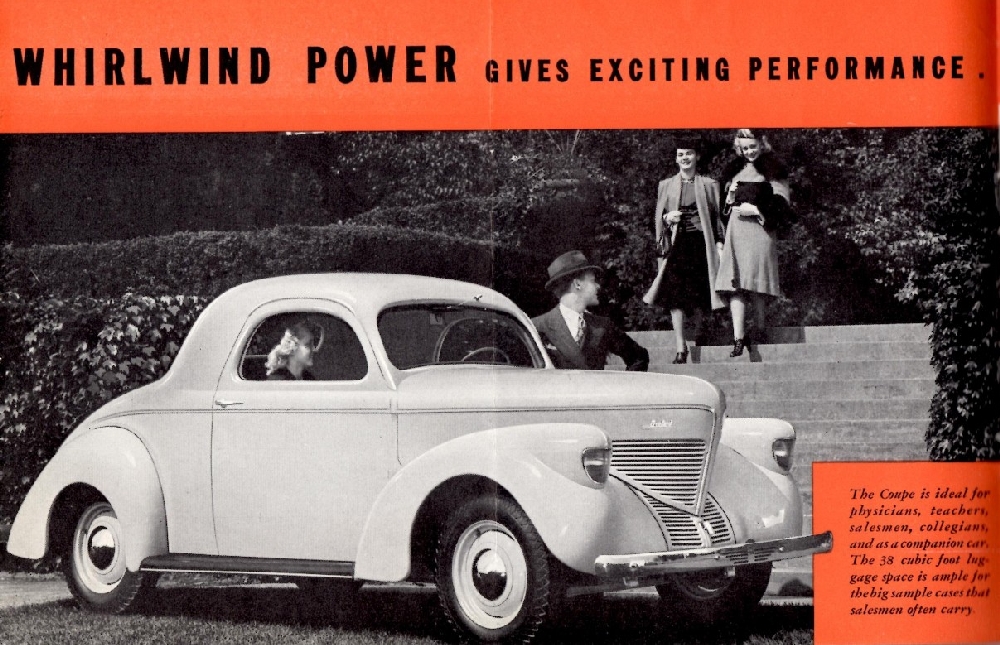
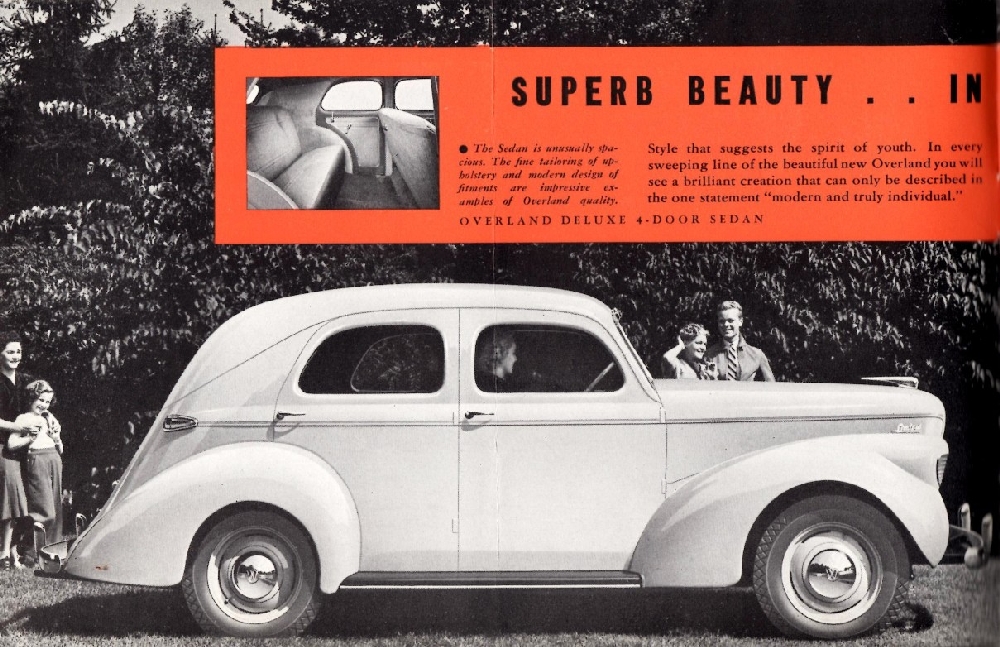
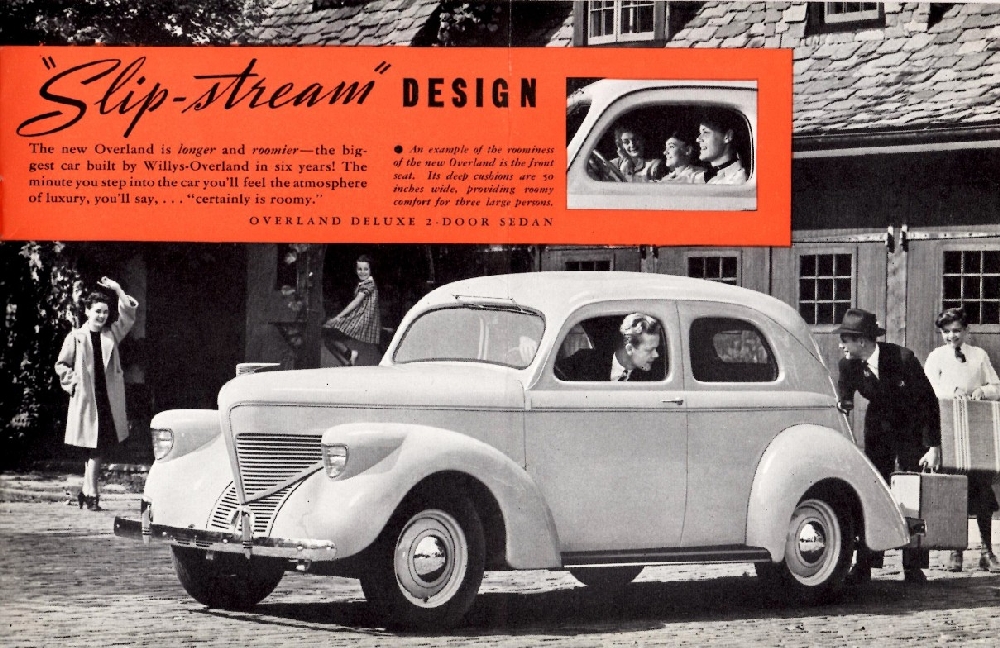
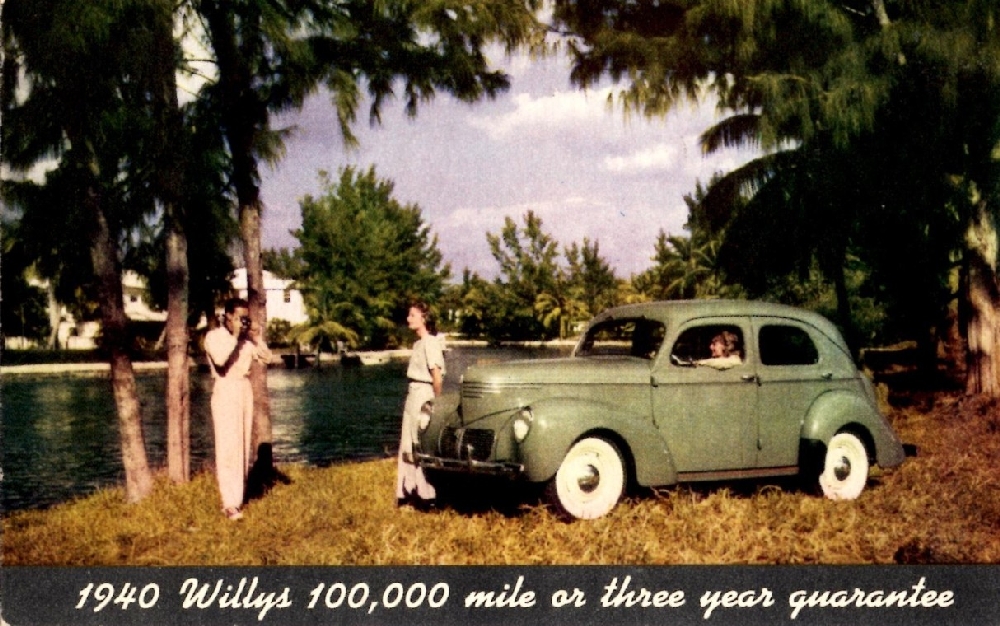
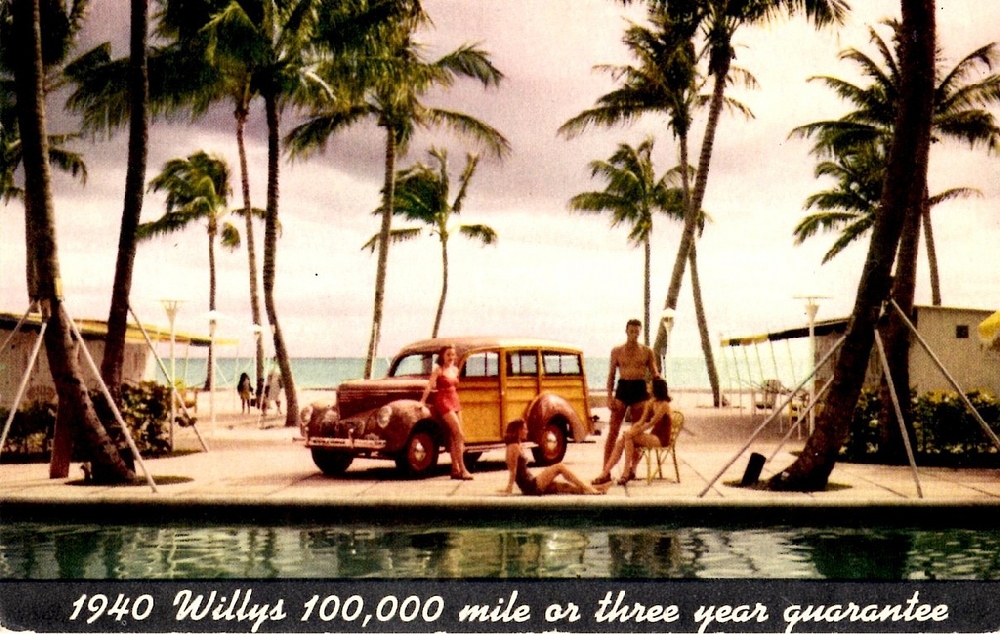
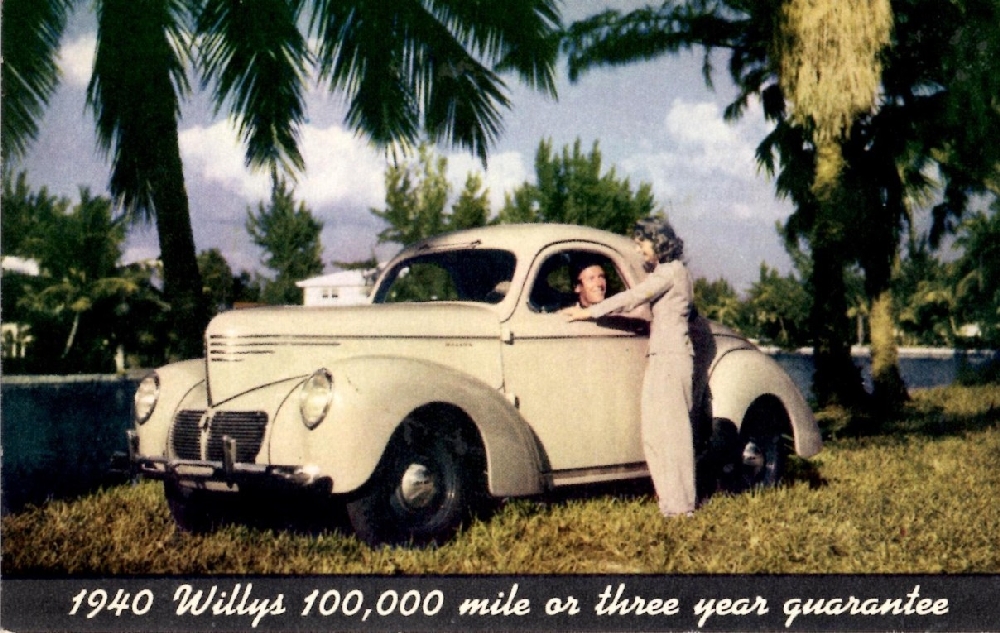
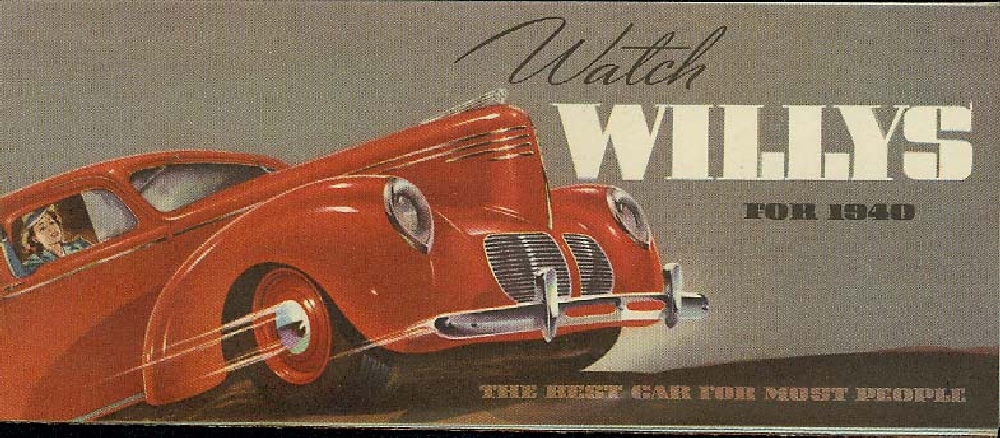
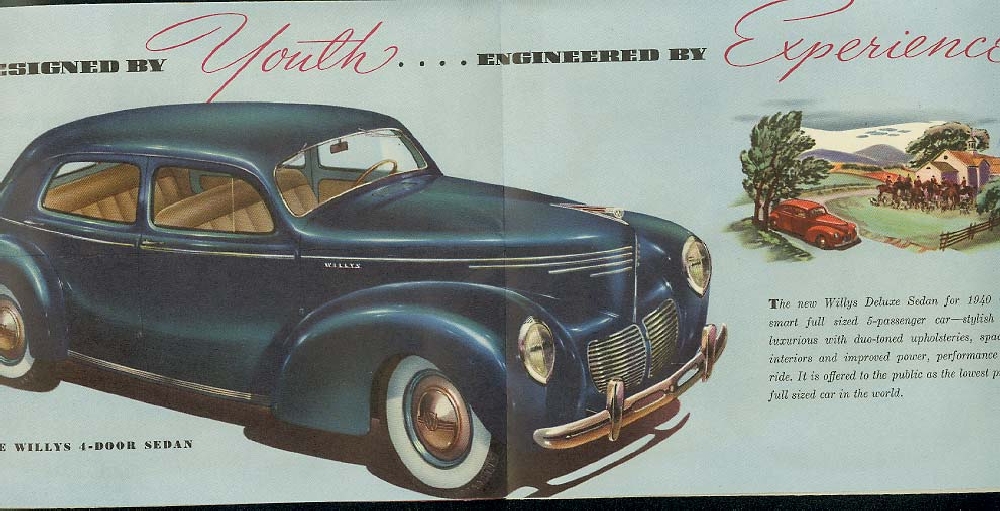
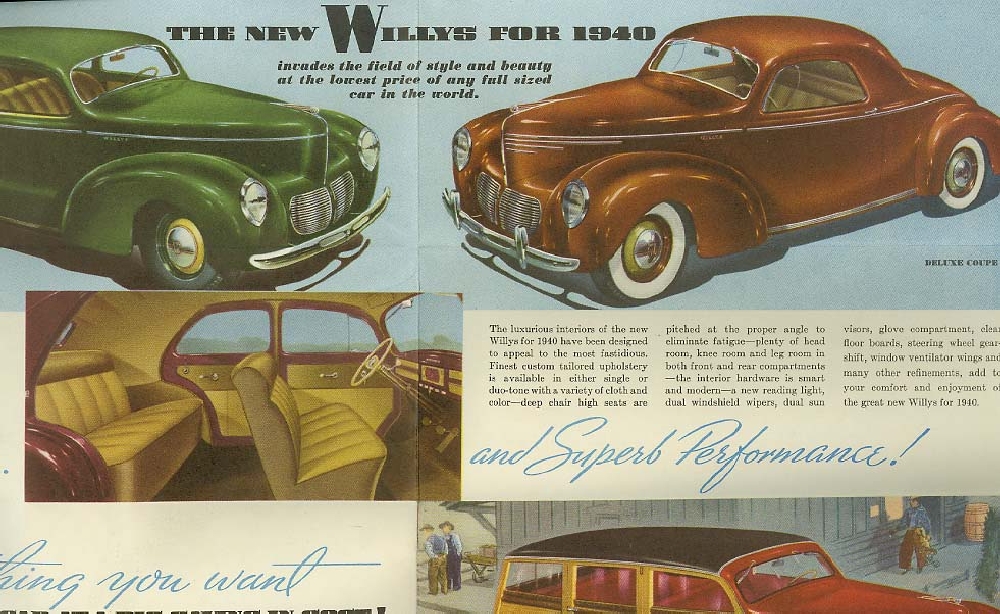
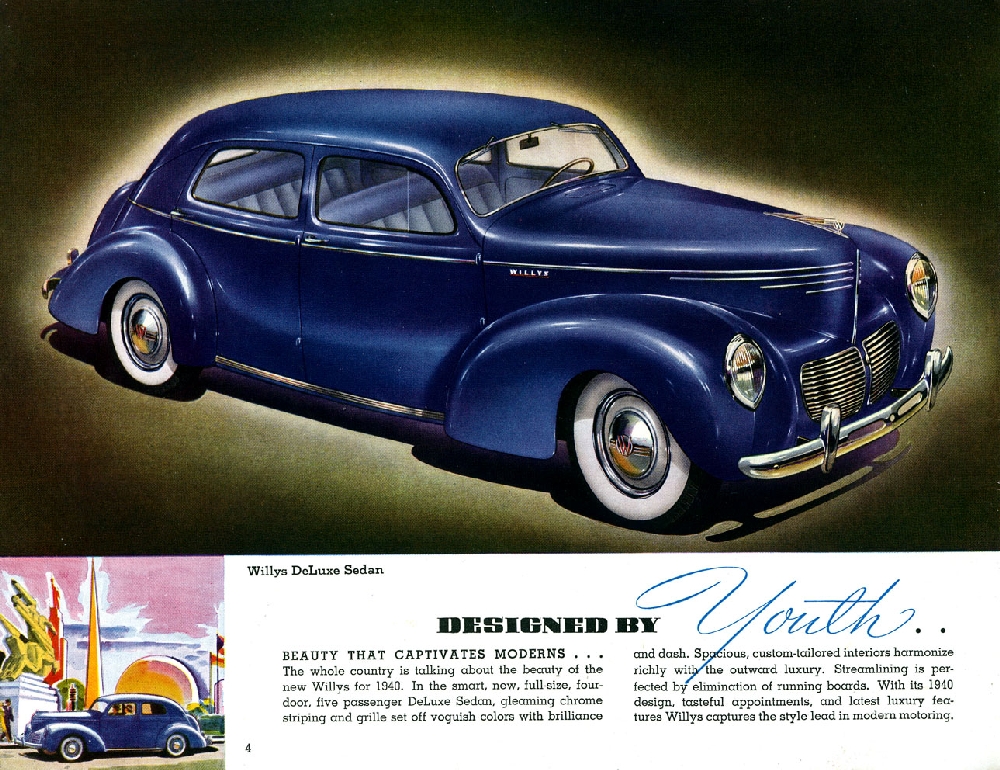
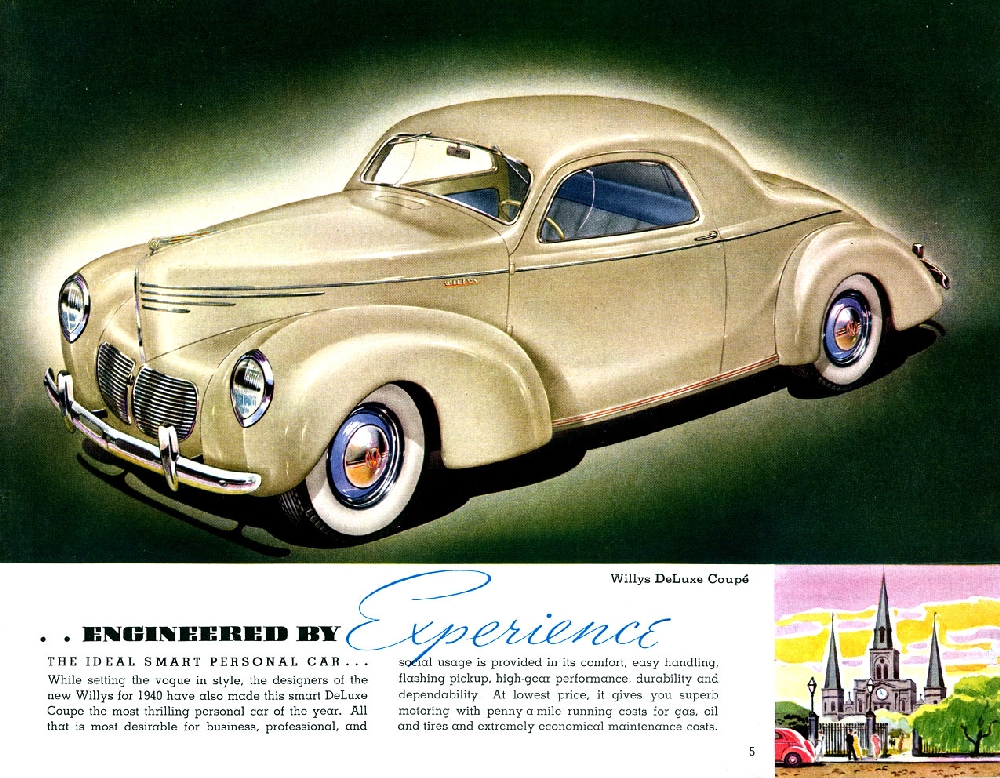
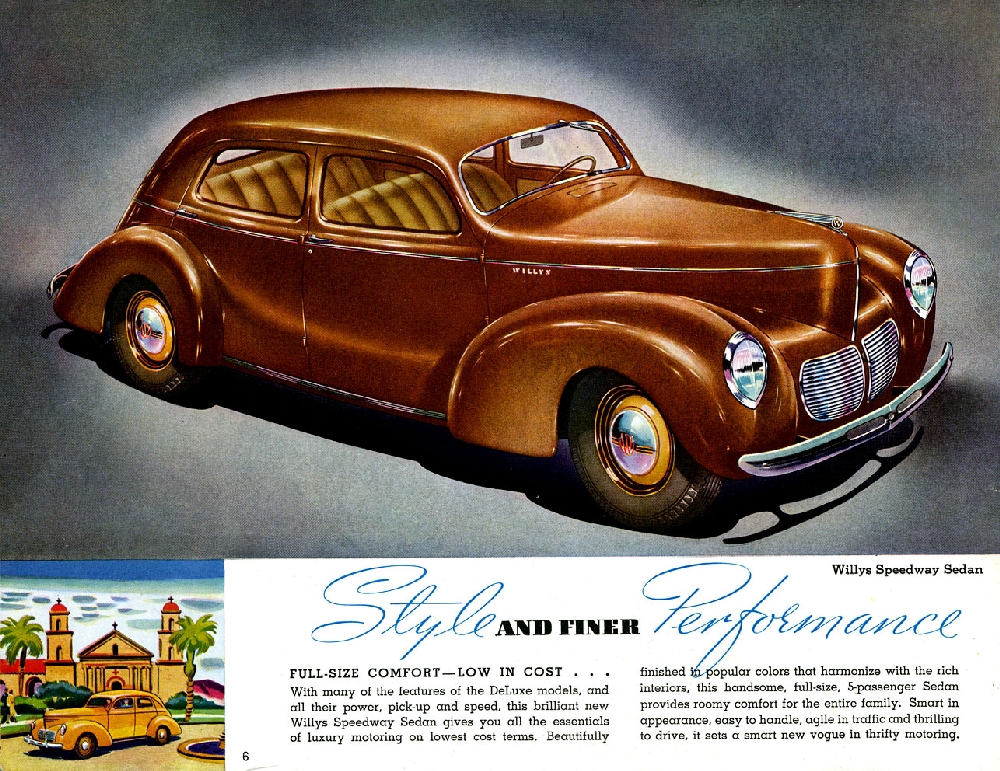
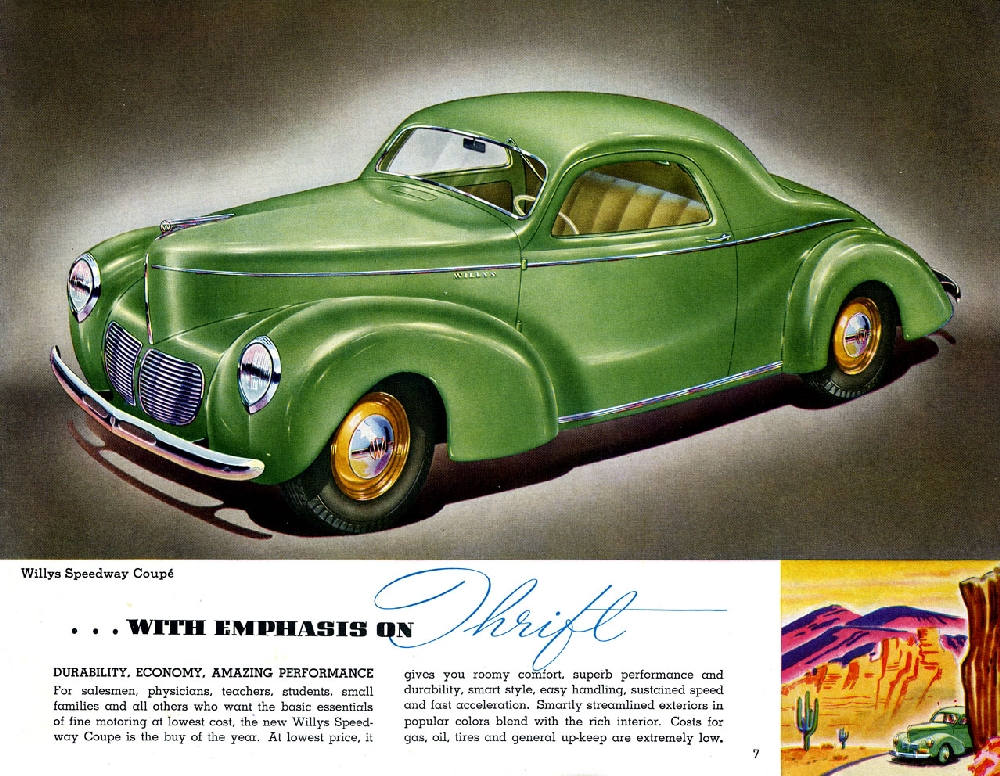
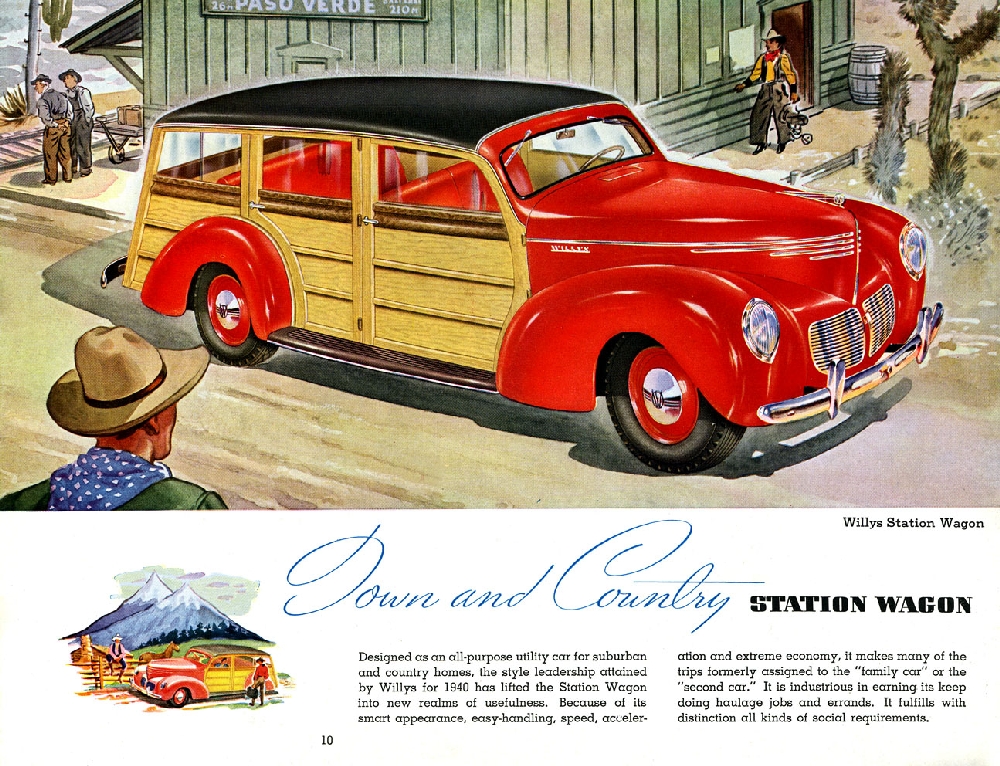
1940 Willys (pictures below):
Models:
- Factory/Dealer Model: 440
- Series / Trim Levels: “Speedway” and “Deluxe”
- Information Taken From Motor Annual Show Number
Special Model: Californian
- Research so far shows that it was produced in the California Willys plant in the Los Angeles area.
- Probably sold on West Coast of USA only.
- Research so far shows this model featured unique interior and exterior trim
- Offered in ’39 and ’40
Specifications:
- Wheelbase: 102”
- Engine: 4 cylinder (used from ’33-’40) – no name for engine given
- Horsepower: 61
- Transmission: 3 speed manual – no overdrive option was available. Speedway (cheaper model) was floor mounted / Deluxe models steering column mount.
- Brakes: hydraulic
- Production: 26,698
Engine Specifications From Brochure:
- Compression ratio: 6.48 to 1
- High altitude head: 6.81 to 1
- Aluminum hi-compression head: 7.0 to 1
Highlights:
- This is only year for 102” wheelbase
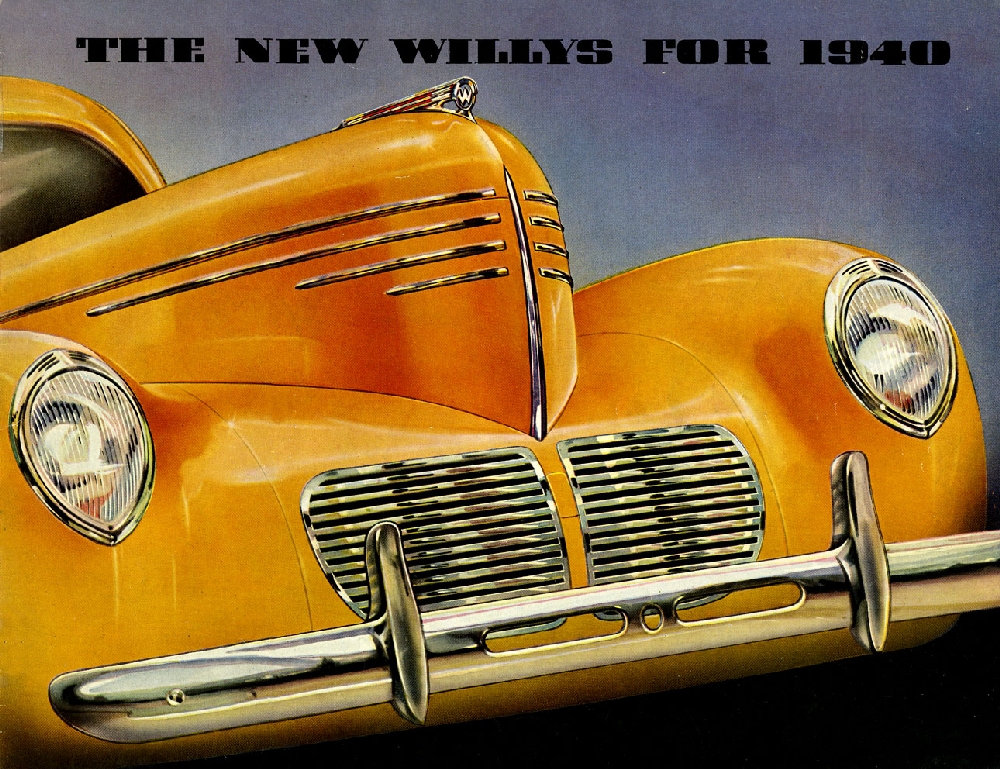
- New front end styling used for one year only
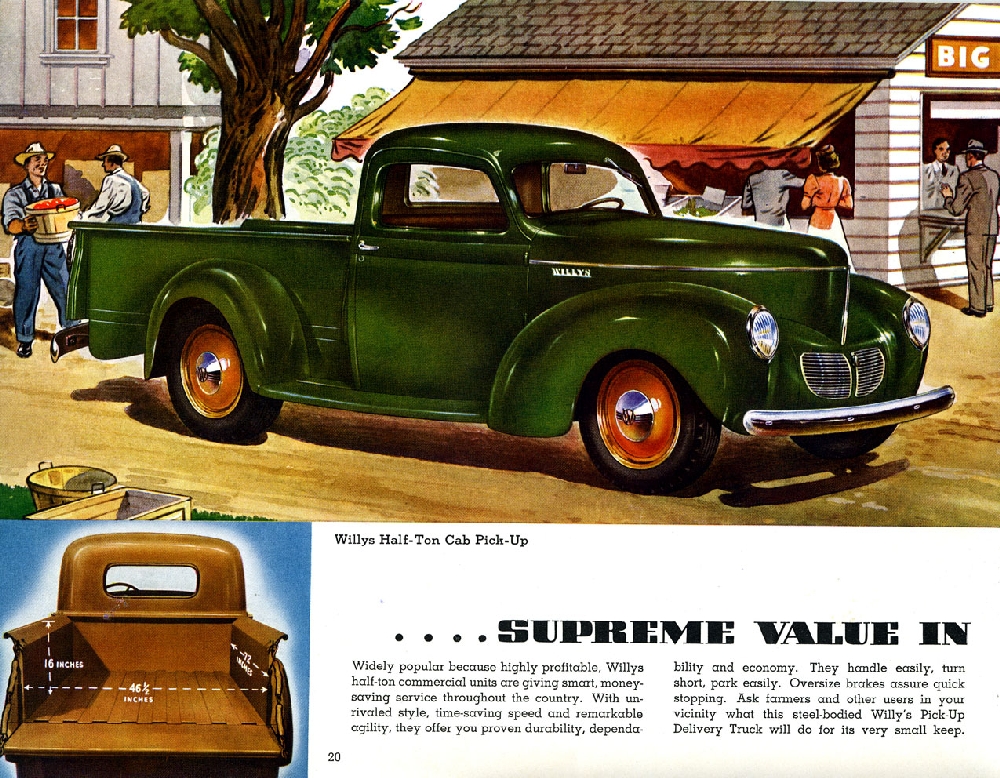
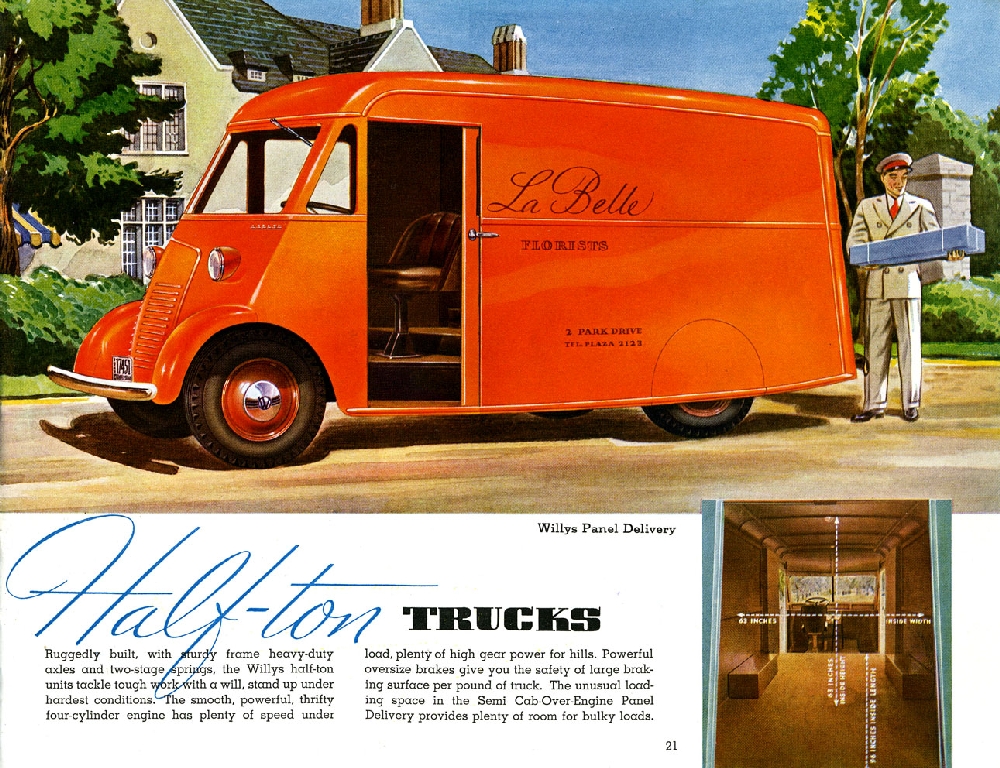
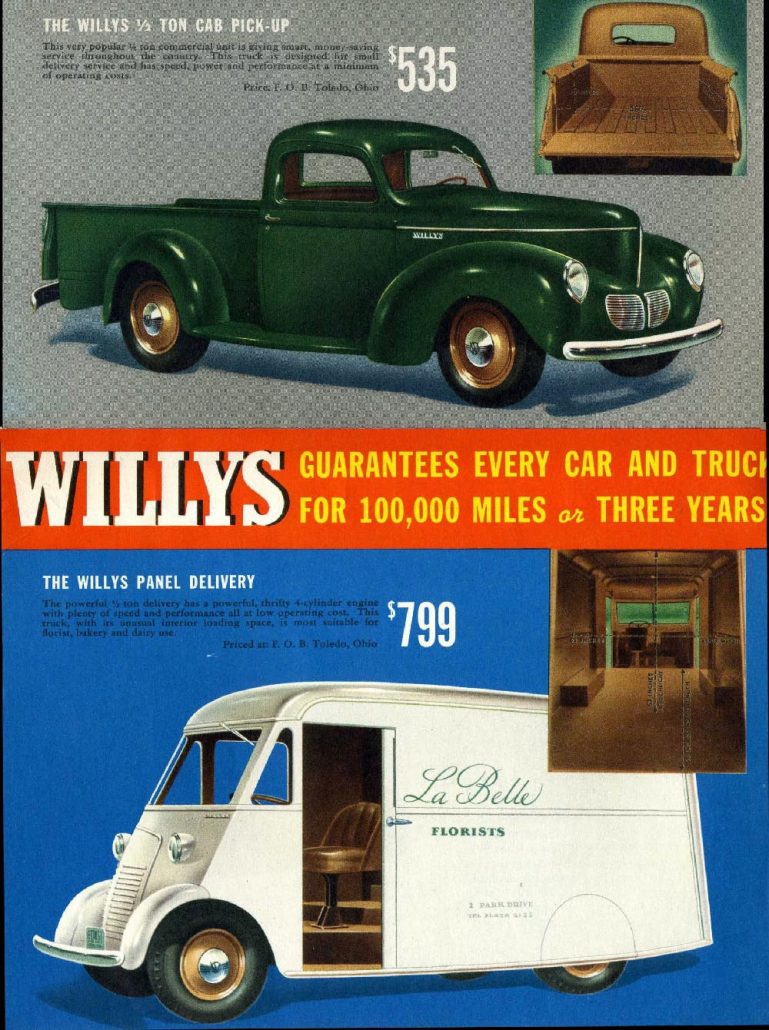
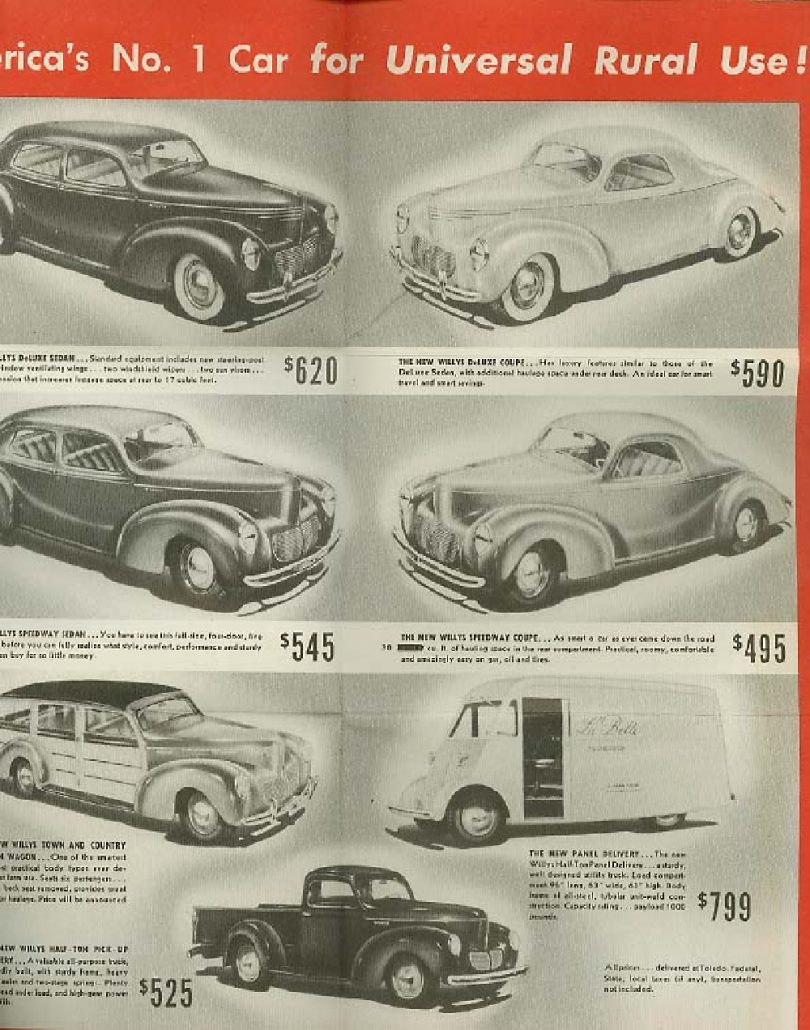
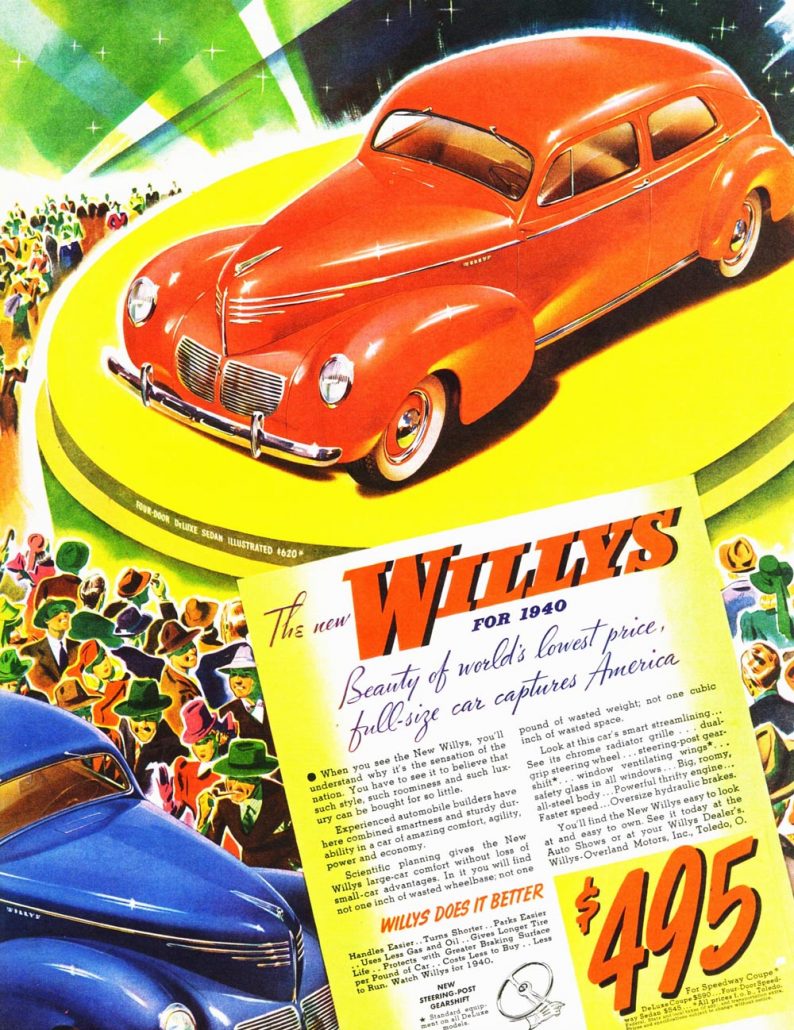
1941 Willys (pictures below):
Models:
- Factory/Dealer Model: 441
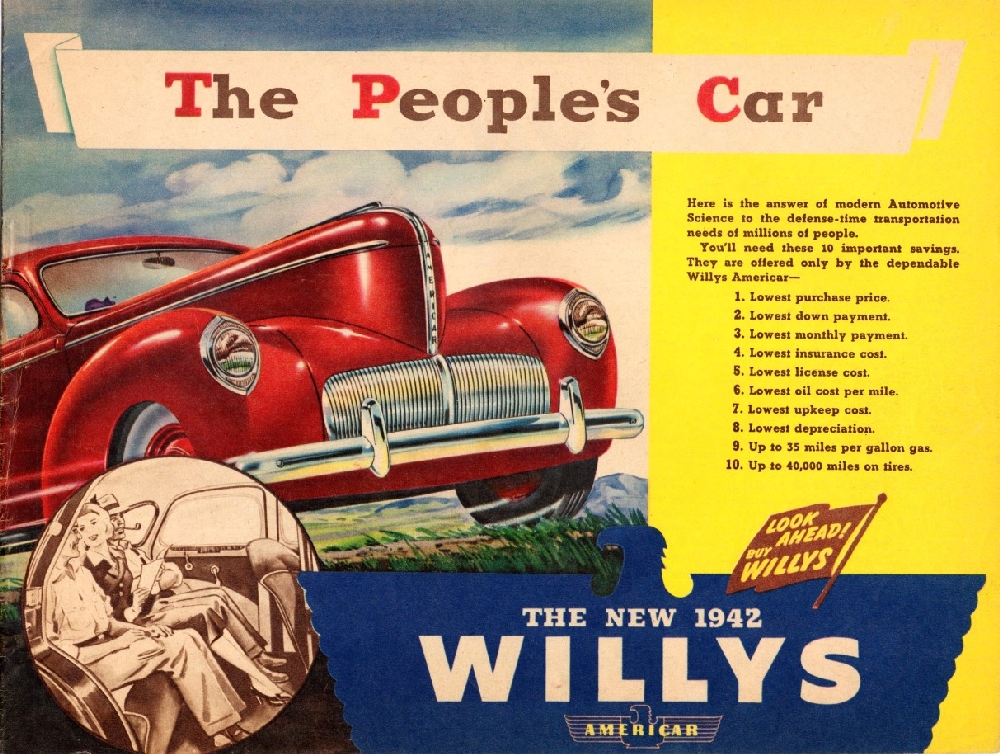
- Series / Trim Levels: “Speedway,” “Speedway Deluxe,” and “Plainsman”
- The name “Americar” applied to all Willys cars in ’41 and ‘42
- Information Taken From Motor Annual Show Number
Special Model: Americar Plainsman
- Research so far shows this model was available only in ‘41
- Here a special engine with an aluminum head and overdrive was standard.
- From the brochure: “The aluminum high compression head which produces high engine output and high torque, combined with high engine efficiency is a prime source of performance when combined with the remarkably efficient Willys-Overland 4 cylinder engine….the automatic overdrive is the second great feature which gives this car great range of performance and flexibility combined with unequaled economy.”
Specifications:
- Wheelbase: 104”
- Engine: 4 cylinder– called the “Americar engine”
- Horsepower: 63
- Transmission: 3 speed manual with optional overdrive – all steering column mount
- Brakes: hyrdraulic
- Production: 28,935
Engine Specifications From Brochure:
- Compression ratio: 6.48 to 1
- High altitude head: 6.81 to 1
- Aluminum hi-compression head: 7.0 to 1
Highlights:
- First year for 104” wheelbase
- ’41-42 Willys virtually same car
- First year for the Americar designation
- First year for overdrive option
- Engine renamed to reflect name of new model car – the Americar Engine
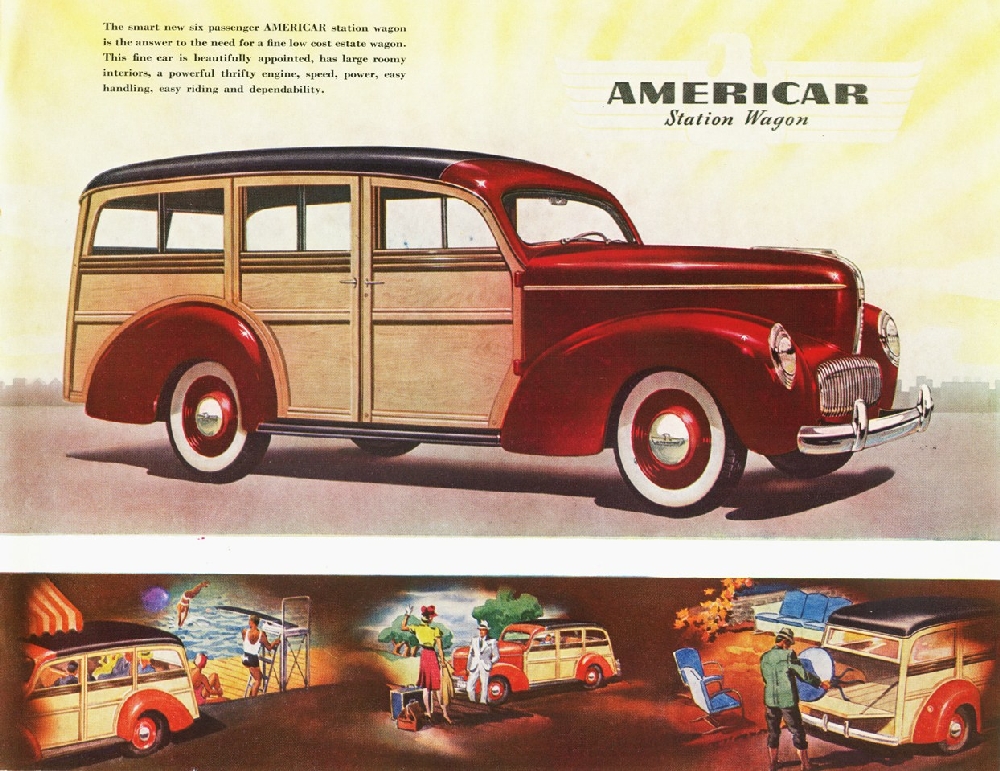
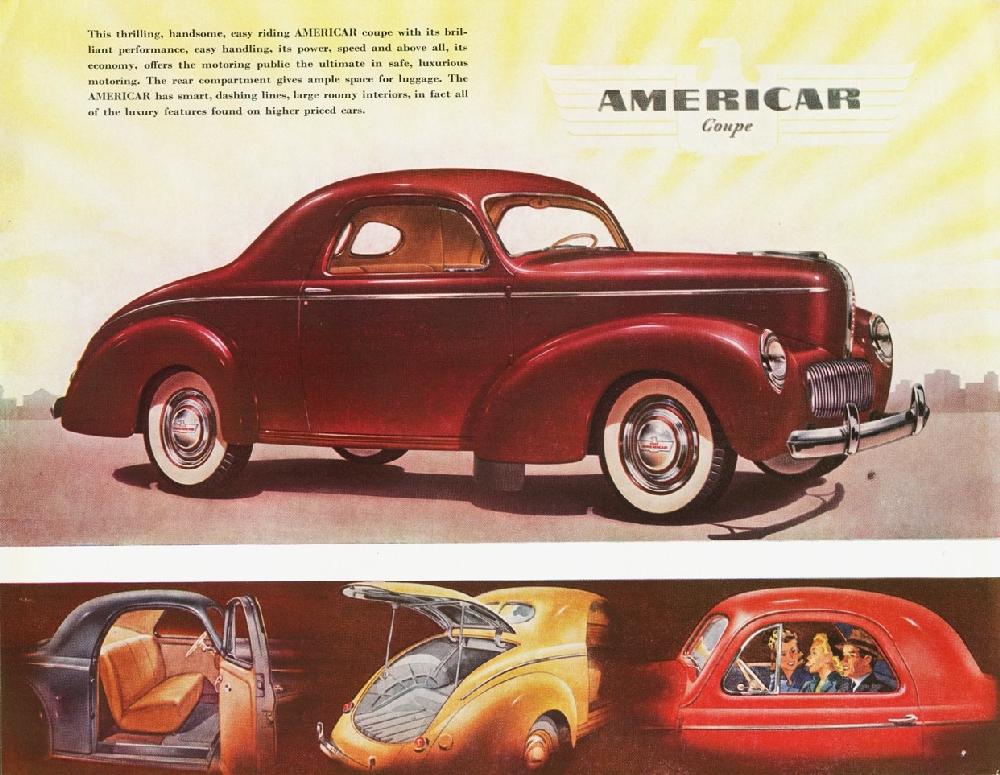
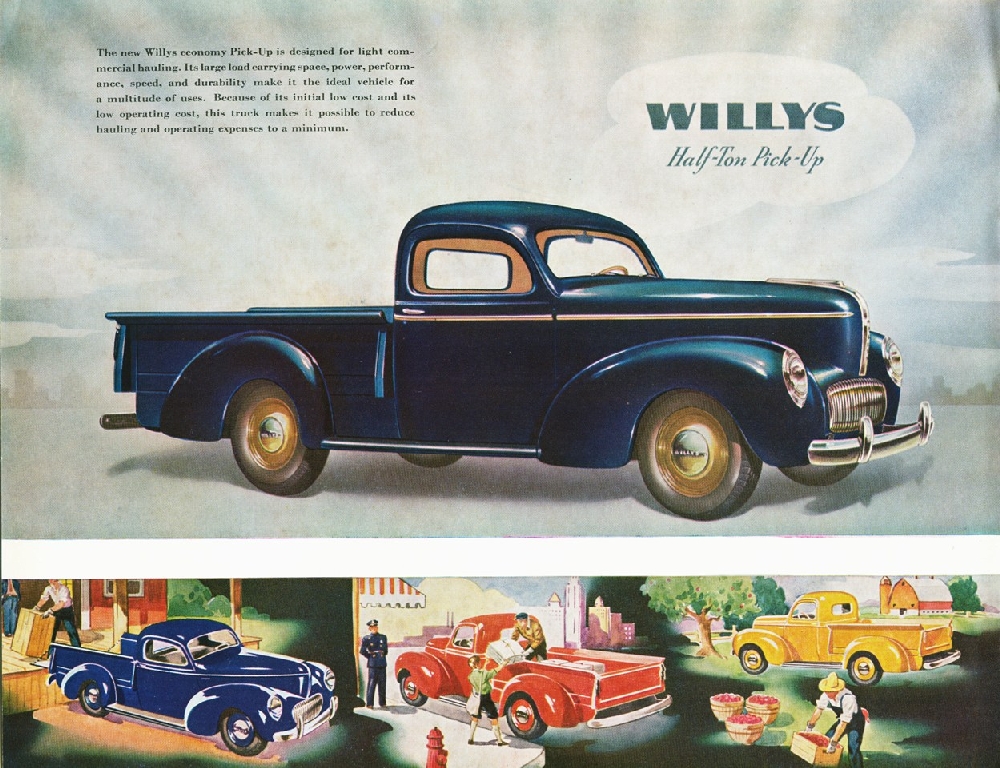
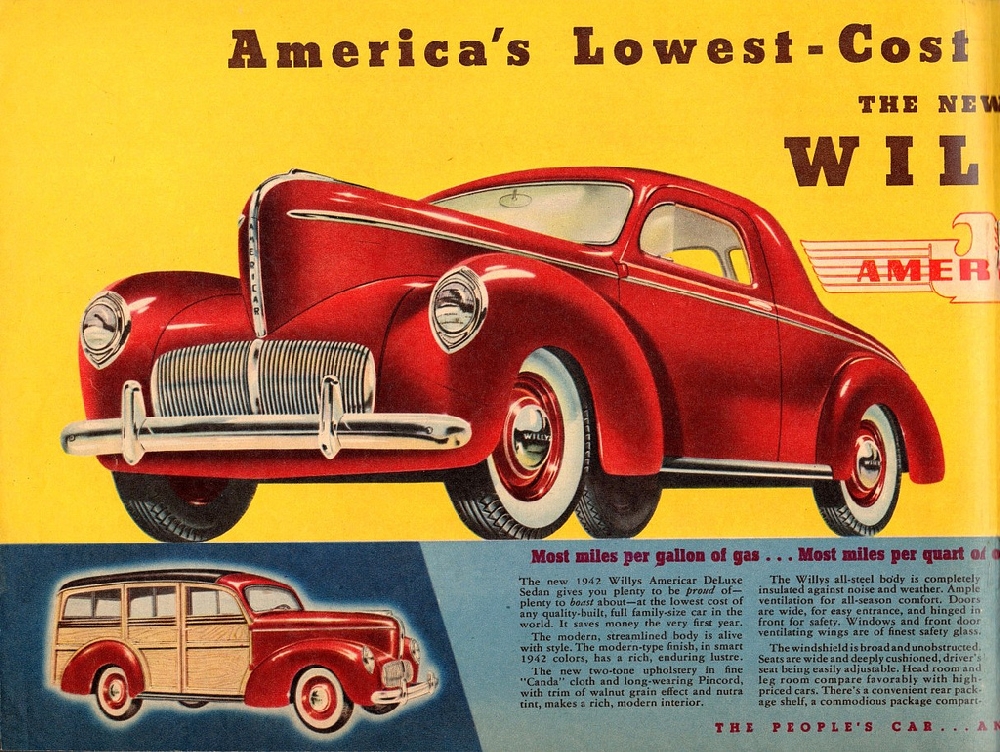
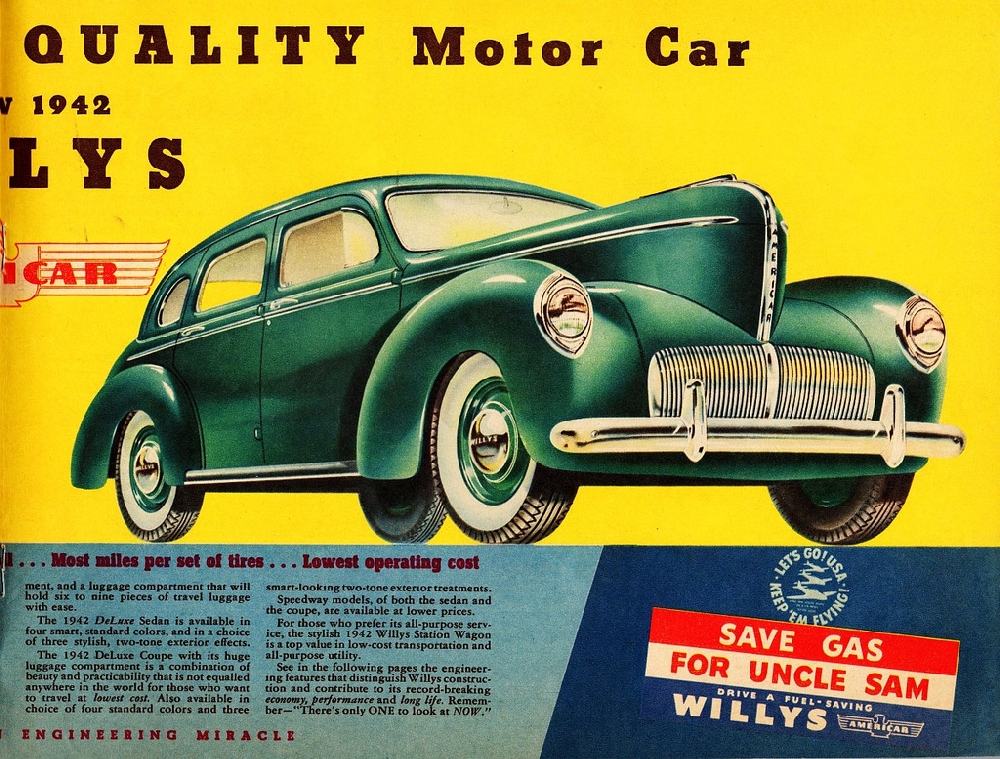
1942 Willys (pictures below):
Models:
- Factory/Dealer Model: 442
- Series / Trim Levels: “Speedway,” and “Deluxe”
- The name “Americar” applied to all Willys cars in ’41 and ‘42
- Information Taken From Motor Annual Show Number
Specifications:
- Wheelbase: 104”
- Engine: 4 cylinder – called the “Go Devil” engine
- Horsepower: 63
- Transmission: 3 speed manual with optional overdrive – all steering column mount
- Brakes: hydraulic
- Production: unknown
Engine Specifications From Brochure:
- Compression ratio: 6.5 to 1
- High altitude head: 6.9 to 1
- Aluminum hi-compression head: (not listed)
Highlights:
- Second year for 104” wheelbase
- ’41-42 Willys virtually same car
- Second and final year for the Americar designation
- Second year for overdrive option
- Engine renamed to reflect name of same engine used in Willys Jeep – The Go Devil engine
Summary:
So for you Glasspar G2 guys out there…..which chassis and engine configuration did Air Force Major Ken Brooks use for the basis of his fiberglass bodied his 1951 “Brooks Boxer” sports car? That answer will be revealed in a future story here at Forgotten Fiberglass 🙂
Hope you enjoyed the story, and until next time…
Glass on gang…
Geoff
——————————————————————-
Click on the Images Below to View Larger Pictures
——————————————————————-
-

- Here’s a Hand-Crafted 1939 “Sharknose” Willys Sport Custom. This Was Not Offered By The Factory – But Is A Favorite Of Both Alden’s And Mine.
I am trying to compile a ridiculously complete list of pickup trucks available when production began after the war. I have a book that says unsold 442 pickups were “listed as available” as late as 1947. Does anyone know if this is true or not? Thanx!
Love the Willys Americar and P.U. , Also Studebaker have several of both…
Nev,
Your 1937 Willys sedan will probably have a T.J.Richards body, with the letters TJR stamped into the firewall.
For info, google “WOCV” for a goldmine of information.
For mechanical parts, Marathon Sparts Company in Tamworth, NSW.
For body parts, willysreplacementparts.com in USA.
Willys are becoming hard to find, and deserve to be respected and restored.
If you do not want to restore, I recommend you search the net for the many companies that build rod chassis for Willys, which are much stronger and safer than the original chassis.
There also many companies that build glass bodies for Willys.
hi all , i,m about to take possession of a 37 willys sedan from a property near moree nsw been in a shed for a lot of years rust free un molested for a $1000, all complete , was a goer
G’day
Great stuff on Willys so far. When you write the book, I will buy a copy!
For info on Willys in Australia, google WOCV, where you will find Willys Overland Club of Victoria, of which I am a founding member.
Your “hand made” model looks remarkably like an Australian Flood body.
The Australian 1937 sedan body was made by T.J.Richards, looks similar to the 1937 U.S.A. model.
The Australian 1938 sedan body was made by Holden, and is a shortened form of the 1938 Chevrolet.
After World War One, very few fully imported cars came to Australia, due to import duty. Chassis, mechanical parts, bonnets (hoods), guards (fenders, or, if you are British- wings) were imported, and fitted to locally built bodies.
There were a number of body builders, producing a variety of body types.
If a customer wanted a ute (coupe utility, please do not call it a pickup – in Australia, that involves a woman standing in the street),and the car dealership was out of stock,they took a coupe off the showroom floor, cut off the back and fitted a ute body. Let’s face it, a coupe was the cheap and nasty bottom-of-the-line product.
There are very few Willys coupes (pronounced coo-pays),(coops are for chickens) left in Australia, as most of those which did not go to the scrap metal dealers, were imported to U.S.A. For some strange reason, a two door car is seen as a symbol of virility in some parts of the world.
In Australia, our racing “Super Cars” have four doors.
Having said that, we also have racing utes!
For more Willys information, I suggest that you research “Willys do Brasil”. Willys were produced in Brazil into the 1970’s, initially as Willys, then later as Fords.
Al the best with your book!
Peter Telfer
Hi i owne a 1941 willys americar sedan ive allwways liked the willys , found one and restored it for my wife an I, we car show all sumer and love it i allso like all the infow I found here i still am lookinking for images of inside the willys plant in 1940/41 showing the cars being built thanks for all tohave read want to know more
No one see the finned 1940 Willys custom in the movie serial?
Australia turned out a multitude of different Willys body styles by companies like T J Richards and Holden.
Sorry Dave, that Willys has an Australian built two door tourer body by a company called Flood. Do some research on the Aussie Willys bodies guys, you will be amazed what we achived down here.
Your first picture you stated it was a custom built 1939, its actually a Holman bodied Willys built in Australia and called a Tourer. Holman Willys had different bodys from American Willys but the noses were the same. There is a lot of Willys in Australia.
Dave.
Holden Body Works not Holman. Holden later became GMH -General Motors Holden.
Holden was the main contracted body builder for Willys vehicles in Australia from mid 20’s until through the end of the 1942 cars.
The exception being the 1937 body production year which was done by the contractor T.J. Richards Body Works with some 1937 Coupe Utilities also being built by Mitchell Body Works. Throughout all these years dealers also contracted local body works whenever Holden and TJR could not supply but these companies usually modified Holden or TRJ bodies into Utilities, Panel Vans and the like and didn’t built complete bodies.
The 1939 tourer was not a custom. It was actually an official Willys body style in Australia that was built for them by Flood Body Works. It was actually called a Sports Tourer and was only made in 1939, 40, 41 & 42.
A few of the 1939 production were based on the Model 48 of 1939 which used the same front sheetmetal shape as the previous 1938 models.
This British style Sports Tourer seated 5 people with a fold forward windscreen, fold down top and cut down doors. The body from the firewall back is wood framed, hence there are not many left. I own a 1940 Sports Tourer.
Darren…excellent points and thanks for sharing. Alden Jewell and I created this article on Willys to support a story coming out tomorrow on the Hemmings Blog about the birth of Glasspar’s Brooks Boxer. The Henry J would have been the late ’50s postwar answer to the 100″ wheelbase “donor” car. The car of choice in the immediate postwar era for many builders would have been the prewar Willys with an approximate 100″ wheelbase.
Lots of interesting stories to share Darren – and thanks for your comments.
Keep ’em coming!
Geoff
Wow! Lovely to see all those old crocks again!
As a very young kid we used to go to the movies on Saturday afternoon mainly to see the serial. I don’t remember what the name of the serial was , but the hero drove what I believe to be a customised white 1940 Willlys? two seater ”sports” car with a big fin on the back. I think it may have had spats on the back as well. It was probably back in the early fifties. Can any one remember it?
TED: The white ’40 Willys roadster that you refer to was custom built and used in the television series of Boston Blackie – that car still exists, however, it’s in need of a total restoration. Geoff has copies of pix that I sent him – perhaps he’ll post them here.
The Kaiser Darrin has a 100″ wheelbase, which was based off of the Kaiser Henry J chassis. In addition, the Darrin used a Willys F-Head six (161 cid).
As we’ve seen, the Henry J chassis has found it’s way under many a fiberglass sports car, and the production Henry Js used Willys engines. They were offered with the l-head 4 or the L-head six (161 cid). While the sixes in both the Henry J and Darrin had the same displacement, the Darrin engine put out 10 HP more because of the in-head valve setup.
Another cool fact is that Howard Darrin began with a Glasspar body and spoke with Bill Tritt at length about his vision (I’m sure we will see more about that in future stories).
F-head Willys engines were in developement in about 1953 for use in the CJ-3, CJ5, the Aero car line and Jeep wagons. In their early stages were not ment to go highway speeds – I had a 1957 CJ 5 that went through rod bearings if run at 60 mph.
The prewar post here has little to do with Willys F-heads.
btw – there is a real neat custom sports car based on a Willys 77 in a Road & Track about 1955. A bodyman built it for his kid – looks like a MG TD.
The first Willys F head engine was the four cylinder F134 which they released in 1950. Perhaps you mean the six cylinder F161 F head engine (new design not a stretched 4 cyl F134) which was first used in the Willys Aerowing cars of 1952.The F161 was never used by the factory to power CJ3, Cj5 or any other similar sized Jeep.
These Willys cars had a little flathead four that was a re-design of the Whippet 4. It was then used in the WWII Jeeps. The design of the 1940 to 1942 cars was close to the 1940 & 41 Lincoln Zephyr and the early 1940s Loewy Studebaker Champion. A few of the Willys Fours were used in midget race cars, and one was built into a sports racer in the early days of the group that became the Sports Car Club of America.
The Willys F Head engine was pretty popular with hot rodders back in the day from what I understand. I never really studied the layout, but there obviously was some sort of performance advantage with this design.
Overall the designs from Willys in the late 1930s were pretty strong. The styling was right up there with the best that was coming off the big three’s lines in my opinion.